Free Art Curriculum by Jen Goya
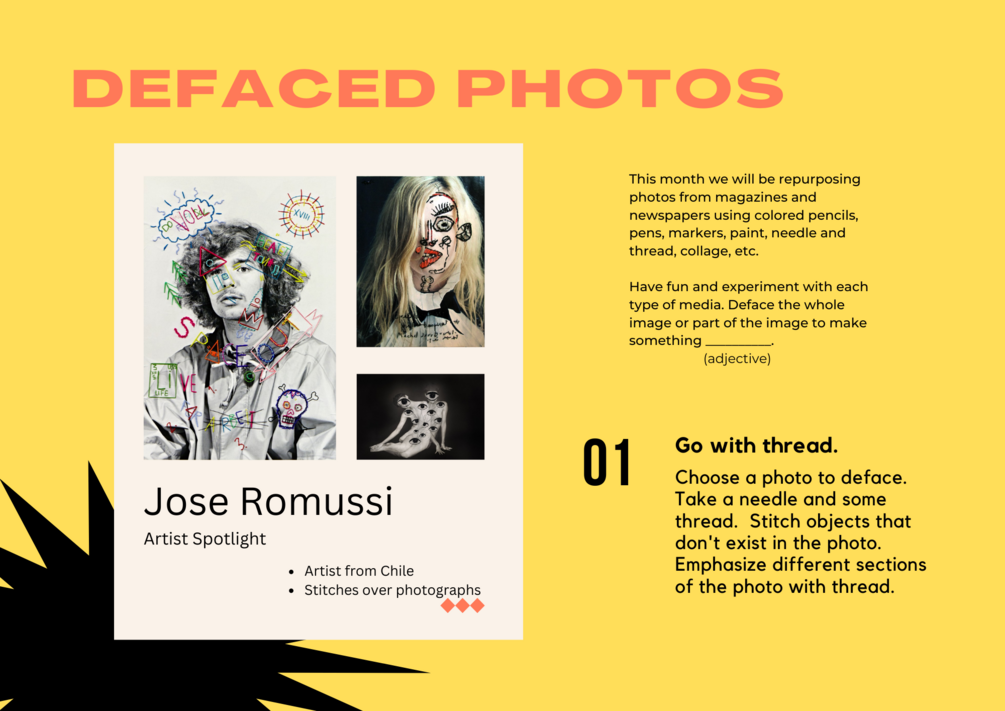
MATERIALS & MEDIA
Required:
- Art journal or sketchbook
- Found photographs (magazines, newspapers, printed images)
Optional Media:
- Pens, markers, colored pencils
- Paint
- Collage materials (paper scraps, text, fabric)
- Needle and thread
- Glue, tape
- Found or recycled materials
ROUTINE & EXPECTATIONS
Routine:
- The Defaced Photos journal is used as a daily or weekly creative warm-up.
- Students spend 10–15 minutes per session working in their art journal.
- Students may continue developing the same photograph over multiple sessions or choose a new image for each entry.
Expectations:
- Speed and experimentation are prioritized over refinement.
- Students are encouraged to take creative risks and try unfamiliar tools or techniques.
- Journal work should show visible evidence of process (layering, marks, changes, or revisions).
Suggested Minimum:
- 8–12 completed journal pages by the end of the unit.
This journal is a low-pressure space for exploration, not a polished final project.
REFLECTION
After each journal entry, students complete a brief reflection. Reflections may be written directly in the journal, on a separate reflection page, or submitted digitally.
Reflection Prompts (choose 1–2):
- What material or technique did you use today?
- What part of the image did you choose to change or emphasize? Why?
- What worked, surprised you, or challenged you?
- If you continued this piece, what would you try next?
Reflections are meant to be short, honest, and process-focused, not formal writing.
ASSESSMENT
Assessment for this unit is process-based rather than product-based.
Students are assessed on:
- Completion of journal entries
- Willingness to experiment and take creative risks
- Use of a variety of tools, materials, or approaches
- Thoughtful engagement with the prompt
- Completion of reflections
Important Note:
Artistic skill, realism, or technical perfection is not the primary focus. The emphasis is on participation, curiosity, and creative problem-solving.
DIFFERENTIATION & ACCESSIBILITY
This unit is designed to be flexible and accessible for a wide range of learners.
Differentiation Options:
- Students may work analog, digital, or hybrid
- Provide pre-selected images for students who struggle to source materials
- Allow drawing-only, collage-only, or digital-only approaches
- Offer simplified prompts for students who need more structure
- Allow students to focus on one image rather than multiple entries
Accessibility Supports:
- No requirement to share personal meaning publicly
- Alternative tools for students with fine motor challenges
- Digital options for students who benefit from undo, zoom, or layering tools
Choice and flexibility are central to this unit’s success.
TEACHER NOTES
- This unit works best when introduced early in the year to establish the Daily Art Journal routine.
- Avoid formal critique; focus on encouragement, curiosity, and process.
- Model defacing an image alongside students to normalize risk-taking.
- Reinforce that altering images is an act of transformation, not destruction.
- Remind students that this journal is a safe space—there is no single “right” outcome.
This unit sets the tone for experimentation and creative confidence for the rest of the year.